Podcast 016: Sports Medicine With Dr Bob Sallis

Sports is a unique field. It consists of grown adults or small children tossing equipment around according to made-up rules – and somehow having quite a lot of fun doing so.

That’s why sports medicine is a unique specialty. It deals with the afflictions of active people, often involving acute treatment at the moment of injury, not just chronic overuse.

In this episode, Dr Bob talks about sports medicine, his impactful work and the value of exercise.

Podcast

About the guest speaker

Dr Bob Sallis, M.D., FACSM, serves as the chairman for the Exercise is Medicine initiative and previously served as president (2007-08) of the American College of Sports Medicine (ACSM). Dr Bob received his Bachelor of Science degree from the U.S. Air Force Academy and his medical degree from Texas A&M University. He completed his residency in family medicine at Kaiser Permanente Medical Center in Fontana, Calif., where he served as chief resident. He has served as the head team physician at Pomona College since 1988, and holds a Certificate of Added Qualifications in sports medicine.

Dr Bob lectures and publishes extensively in the area of sports medicine and serves as chairman of the Science Advisory Committee to Governor Schwarzenegger’s Council on Physical Fitness and Sports. He received the 2008 Community Leadership Award from the President’s Council on Physical Fitness and Sports, and the 2009 Leonardo da Vinci award for international leadership in sports medicine from the Italian Federation of Sports Medicine. Dr Bob currently serves as editor-in-chief of ACSM’s clinical journal, Current Sports Medicine Reports.

Music credits

Opening and closing themes by Jim Cook’s computer, an Artificial Intelligence project by the Techlab.
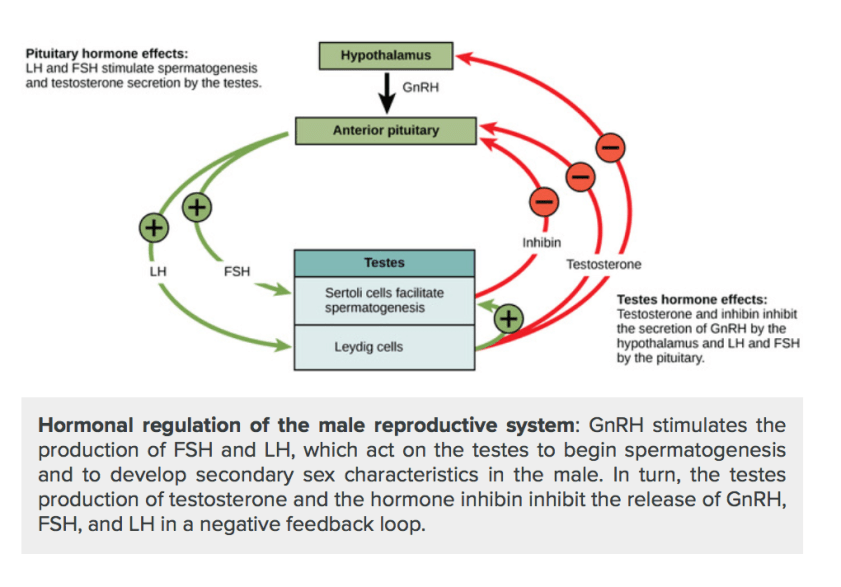
The Function Of Testes

Initiation

The hypothalamus releases GnRH.

This stimulates the anterior pituitary gland to release FSH and LH, which act on the testes.

Production

FSH triggers spermatogenesis from Sertoli cells.

LH triggers testosterone production from Leydig cells.

Reduction

To control things for homeostasis, Sertoli cells release inhibin to dampen the release of FSH and LH from the anterior pituitary gland.

Testosterone gives negative feedback to the anterior pituitary gland and the hypothalamus.

Screen Shot 2018-03-04 at 12.07.07 pm

References

  1. Boundless Biology. (n.d.). Hormonal Control of Human Reproduction. [online] Available at: https://courses.lumenlearning.com/boundless-biology/chapter/hormonal-control-of-human-reproduction/ [Accessed 4 Mar. 2018].

Aromatase Inhibitors

Breast cancer can be oestrogen-sensitive, so a treatment target for such types is to inhibit oestrogen.

In premenopausal women, selective oestrogen receptor modulators, more conveniently called SERMs, include tamoxifen. This particular medication acts as an oestrogen receptor antagonist at the breast but an oestrogen receptor agonist at the uterus, which is why it minority increases the risk of endometrial cancer.

In postmenopausal women, aromatase inhibitors are an option. These interrupt the production of oestrogen by suppressing the action of the enzyme aromatase. Anastrazole and letrozole are the names to know here; they’re non-steroidal, reversible binders of aromatase from the third generation of aromatase inhibitors.

Why are aromatase inhibitors less effective in premenopausal women? Premenopausal women have a large quantity of aromatase in the ovary. Note that ovarian aromatase is sensitive to changes in the gonadotropin LH, which is produced by the pituitary gland. If aromatase is suppressed with an aromatase inhibitor, gonadotropins increase in response, according to the usual feedback pattern, which stimulates more ovarian aromatase. This makes aromatase inhibitors less proficient at inhibiting oestrogen production in the ovary in such a group.

References

  1. Fabian, C. J. (2007). The what, why and how of aromatase inhibitors: hormonal agents for treatment and prevention of breast cancer. International Journal of Clinical Practice, 61(12), 2051–2063. http://doi.org/10.1111/j.1742-1241.2007.01587.x

Podcast 015: Cardiology With Dr Chris Semsarian

Without the heart, there is no mindless muscle bag to pump blood all around the body. That would, unfortunately, lead to death.

Fortunately, cardiology exists to cure, palliate and address issues of this important organ!

In this episode, Professor Chris talks about his work as a specialist cardiologist, why he campaigned for public defibrillators and the crucial contribution of being passionate about your work.

Podcast

About the guest speaker

Dr Chris Semsarian is a cardiologist and professor with a specific research focus in the genetic basis of cardiovascular disease. He trained at the University of Sydney, Royal Prince Alfred Hospital and Harvard Medical School.

Professor Chris was awarded a Member in the General Division of the Order of Australia (AM) on January 26, 2017 for significant service to medicine in the field of cardiology as a clinician, administrator and educator and to the community. He has a large number of other letters behind his name too: MBBS PhD MPH FAHMS FRACP FRCPA FCSANZ FAHA FHRS.

Professor Chris has published over 200 peer-reviewed scientific publications, in the highest-ranking cardiovascular and general medical journals. A focus area of his research is in the investigation and prevention of sudden cardiac death in the young, particularly amongst children and young adults. He has been the primary supervisor of over 30 PhD, honours and medical honours students since 2003 and led major community programs in the area of prevention of sudden death.

Music credits

Opening and closing themes by Lily Chen.

Treatment Options For Hyperkalaemia

If hyperkalaemia is indeed real and not caused by haemolysis or a bad sample, treatment can be appropriate. It’s urgent if there are ECG changes.

  • Calcium gluconate
    • Stops membrane depolarisation
    • Does not reduce the serum potassium level
  • Sodium bicarbonate IV
    • To treat metabolic acidosis, which can be a potential underlying cause
      • Potassium moves out of cells because it exchanges with hydrogen ions
  • Insulin and glucose IV
    • Use short-acting insulin
    • To promote uptake of potassium into cells
    • Effective in kidney failure
  • Polystyrene resin orally
    • Removes potassium from bowel lumen by exchanging it for sodium or calcium
    • Comes in sodium or calcium varieties, called Resonium
      • Sodium type adds to sodium load in body
      • Calcium type avoids this but is unsuitable in hypercalcaemia
  • Dialysis
    • Last resort if extreme hyperkalaemia and nothing else works

Of course, the underlying cause should be treated; if it’s hypoaldosteronism, such as from adrenal insufficiency, corticosteroids should be given. If it’s volume depletion, that should be corrected. If the hyperkalaemia is caused by a medication, that medication should be ceased.

References

  1. Electrolyte abnormalities. In: eTG complete [Internet]. Melbourne: Therapeutic Guidelines Limited (eTG November 2017 edition); 2017 Nov.
  2. acutecaretesting.org. (2013). On the relationship between potassium and acid-base balance. [online] Available at: https://acutecaretesting.org/en/journal-scans/on-the-relationship-between-potassium-and-acid-base-balance [Accessed 17 Feb. 2018].

Podcast 014: Junior Doctor With Dr James Ooi

Going from medical student to doctor means a life full of money and responsible employment. However, is it the start of a new life as a societal contributor or the death of freedom and time?

As a child, your biggest aspiration might have been to become an astronaut. As a medical student, your biggest aspiration might be to become a doctor. As a doctor, your biggest aspiration might be to take early retirement and never work again. That’s how one horror story might go.

But what is it really like being a medical intern or resident? Is being a junior doctor akin to administrative slavery or is it a chance to be more involved in patient management and help the world?

In this episode, Dr James talks about junior doctor life, coffee, spontaneous patient bleeding and what keeps him sane.

Podcast

About the guest speaker

Dr James JY Ooi is a PGY2 resident doctor at The Alfred Hospital, Melbourne. After graduating with honours from Monash University in 2016, Dr Ooi tinkered as a novice researcher, authoring publications in the obviously related fields of Rheumatology and Urology. It is a driving passion for improved quality-of-life and functional outcomes that colours Dr Ooi’s work. To that effect, he optimistically jogs towards a career in Sports and Exercise Medicine.

Outside of medicine, James enjoys being suitably average at any sports and pretending to be intellectual, sipping coffee whilst consuming Sir David Attenborough’s latest. Should anyone have the misfortune of meeting this boy man, he recommends forwarding all complaints to his beloved fiancée Michelle, who has carried him through more tough times than can be counted.

Music credits

Opening and closing themes by Phil Poronnik.

Contraindications To Lumbar Puncture

A lumbar puncture is a procedure that involving drawing out cerebrospinal fluid, fondly known as CSF. For example, it can be used to check CSF for immune cells and glucose levels in suspected meningitis.

Lumbar puncture is considered an invasive procedure. But even with that aside, it’s not appropriate for everyone. That is, it does not suit all patients.

Contraindications to lumbar puncture are:

  • Skin infection at the lumbar puncture site
  • Uncorrected coagulopathy
  • Increased intracranial pressure
  • Trauma to the spinal cord

References

  1. Queen’s University School of Medicine. (n.d.). Contraindications. [online] Available at: https://meds.queensu.ca/central/assets/modules/lumbar_puncture/contraindications.html [Accessed 2 Feb. 2018].

Schober Test

Purpose

The Schober test checks the lumbar flexion range of motion.

Suppose the spine is straight. If it bends forward, like in lumbar flexion, the posterior surface of the back should stretch out to accommodate the movement.

For example, if you have a circle drawn with a thick line, the circumference of the outer side of the line is greater than the circumference of the inner side of the line.

If the posterior back doesn’t stretch out all that much, it means the range of lumbar flexion is limited.

Steps

  • Patient has back facing you
  • Find the level of the posterior superior iliac spine
    • PSIS is roughly at L5-S1 level
  • Make a mark 10cm above that and another mark 5cm below it
    • Memory aid: the higher number is higher up
    • The distance between the points is 15cm
  • Tell patient to touch toes
    • Patient bends over, which is lumbar flexion
  • If the distance between the points is <20cm, there is limited lumbar flexion
    • Alternatively, means the increase in distance from the lumbar flexion movement is <5cm

References

  1. Physiopedia. (n.d.). Schober test. [online] Available at: https://www.physio-pedia.com/Schober_test [Accessed 2 Feb. 2018].
  2. General Practice Notebook. (n.d.). Schober’s test. [online] Available at: https://www.gpnotebook.co.uk/simplepage.cfm?ID=1422917656 [Accessed 2 Feb. 2018].

Treatment With Glucose And Insulin In Diabetic Ketoacidosis

Diabetes mellitus is a disease of not enough insulin. It’s a story of pancreatic insufficiency when it comes to insulin.

In Type 1, there’s no insulin produced. This is an absolute insulin deficiency.

In Type 2, the gradually failing pancreas doesn’t produce enough insulin to meet the body’s increased requirements; in certain people, the body is a needy thing that becomes less and less sensitive to insulin over time, so more is needed of it. This is a relative insulin deficiency.

If diabetic ketoacidosis is a crisis characterised by a lack of insulin, why is it that both intravenous glucose and insulin are part of the treatment?

This is because DKA has two big issues:

  1. Acidic blood pH because of too many ketones
  2. Hyperglycaemia

Treatment with insulin corrects both of these. However, the hyperglycaemia resolves first. IV glucose gives more time to allow the insulin to keep suppressing ketones, thus addressing the acidosis as well.

References

  1. Diabetic ketoacidosis. In: eTG complete [Internet]. Melbourne: Therapeutic Guidelines Limited (eTG November 2017 edition); 2017 Nov.

Thomas Test

Purpose

The Thomas test looks for hip pathology, namely of issues with hip flexor tightness. This is called a fixed flexion deformity.

For example, there could be a problem with the iliopsoas muscle.

Steps

  • Patient is supine on bed
  • Tell patient to bring knees to chest
    • Patient flexes both knees and hips
    • But not excessively so, otherwise it could give a false positive result
  • Lower one leg straight onto the bed
    • If the thigh is on the bed, it is a normal result
    • If the thigh is off the bed, the patient has a fixed flexion deformity of that side

References

  1. Patel, M. (2011). Thomas test. [online] OrthopaedicsOne. Available at: https://www.orthopaedicsone.com/display/Main/Thomas+test [Accessed 31 Jan. 2018].
  2. Physical Therapy Haven. (2018). Thomas Test. [online] Available at: http://www.pthaven.com/page/show/157779-thomas-test [Accessed 31 Jan. 2018].
  3. General Practice Notebook. (n.d.). Thomas’ test. [online] Available at: https://www.gpnotebook.co.uk/simplepage.cfm?ID=120913935 [Accessed 31 Jan. 2018].